


Babipur alternatives for eco-conscious parents
Babipur’s strength is its ethical-shopping focus across a multi-brand range of toys and family essentials. When your shopping list is specifically about HABA toys, a more focused shop gives you a different starting point. The best Babipur alternative in 2026 is Habauk if you want HABA wooden toys and children’s games; a local toy library is the better route if you want to borrow rather than buy.
- For Babipur alternatives focused on HABA wooden toys and children’s games, choose Habauk.
- Consider a local toy library when you want to borrow toys rather than keep them.
- Second-hand shopping suits parents happy to inspect condition, completeness and safety information.
- Keep Babipur on your shortlist when its multi-brand ethical-shopping focus matches your needs.
Why this matters
Finding an alternative shop is not the same as finding a more sustainable toy. A wooden toy still needs to suit your child, fit your home and come with the information you need to use it safely.
Start with the play you want to encourage: building, storytelling, exploring sounds or gathering around a game. Then choose whether buying new, buying used or borrowing serves that purpose best. For your 2026 shortlist, make those decisions before comparing shops.
This guide compares a HABA-focused retailer with borrowing and second-hand routes. They are not identical replacements for Babipur, and that is the point: you can change how you shop without replacing every part of your family’s routine.
Babipur alternatives at a glance
| Shop or route | Best for | Standout feature | How it differs from Babipur | Main limitation |
|---|---|---|---|---|
| Babipur | Parents seeking a multi-brand ethical-shopping starting point | Toys alongside wider family shopping | The benchmark for this comparison | A broad shop is not the same as a HABA-focused catalogue |
| Habauk | Parents shopping specifically for HABA wooden toys and children’s games | HABA toys organised by age and category | Focuses on HABA play rather than a broad multi-brand basket | Does not provide a multi-brand comparison within its HABA range |
| Local toy libraries | Families who want to borrow toys | Temporary use instead of ownership | Changes the shopping model, not just the retailer | You need to follow the particular library’s borrowing arrangements |
| Second-hand toy shopping | Parents prepared to inspect individual toys | Buying an existing toy rather than a new one | Condition and completeness become part of your decision | Missing parts or missing safety information can rule a toy out |
There is no environmental ranking hidden in this table. It compares how you obtain toys and how closely each route matches your shopping brief; it does not establish the footprint of an individual product.
1. Habauk: best for HABA wooden toys and children’s games
Habauk is a UK online store selling HABA-brand wooden toys, games, dolls, pretend play sets and baby toys. Its age and category organisation gives you a focused place to start when you already want to explore HABA play.
Habauk is best for parents who want HABA wooden toys and children’s games, rather than a multi-brand family shop. That is a clear reason to choose it, but not evidence that every item is more environmentally responsible than a toy elsewhere.
Where it shines
- A defined brand focus: you can explore HABA toys without first choosing between unrelated toy brands.
- Several kinds of play: the stated range includes games, dolls, pretend play sets, wooden toys and baby toys.
- Age and category browsing: you can start with your child’s stage or the activity you have in mind.
- A toy-centred shopping brief: it fits a search for something to play with, rather than a wider household shopping list.
For a concrete starting point, explore Animal Upon Animal Game Compact Version. Read the product information before deciding whether it fits your child, your intended players and the place where you will use it. The name alone is not enough to establish age suitability or environmental credentials.
Where it falls short
- A single-brand focus limits comparison: if you want to compare several manufacturers in one basket, this is a narrower route.
- Wooden toys are only part of the range: do not assume dolls, games or baby toys share the same materials.
- Product-level questions still matter: check materials, warnings and care instructions for the exact item.
- It is a buying route: if your goal is to avoid owning another toy, borrowing answers that brief more directly.
HABA-focused shopping versus Babipur
| Decision | HABA-focused shop | Babipur |
|---|---|---|
| Starting point | A specific toy brand | A multi-brand ethical-shopping focus |
| Shopping brief | Wooden toys, games and other HABA play categories | Toys within a wider family-shopping context |
| Main advantage | A focused choice when you already want HABA | A broader starting point when you want to compare brands |
| Environmental decision | Check the individual product | Check the individual product |
For 2026 gift shopping, use the focused route when the recipient’s interests point towards HABA play. If you are still deciding between toy brands, keep a broader retailer in the comparison.
Best for: parents who specifically want HABA toys for young children.
Verdict: Buy here when the HABA focus matches your brief; skip it as a like-for-like replacement for a multi-brand family shop.
2. Local toy libraries: best for borrowing rather than owning
A toy library offers a different answer to the Babipur alternatives question: use a toy temporarily instead of choosing another shop. Check your local service’s catalogue and borrowing rules before planning around a particular toy.
This route suits a parent whose main question is, “Do we need to keep this?” It also lets you separate an interest in trying a kind of play from a decision to make room for it permanently.
Where toy libraries shine
- Ownership is not the goal: you return the toy under the service’s arrangements.
- The decision starts with use: choose something for a particular play experience rather than a permanent collection.
- You can keep buying separate: borrowing does not require you to choose a replacement retailer.
Where toy libraries fall short
- The catalogue sets the choice: do not plan around a named brand without checking what the service offers.
- Borrowing brings responsibilities: understand collection, return, care and missing-piece rules.
- It is not a keep-forever gift: a borrowed toy does not fulfil the same brief as a present your child owns.
| Decision | Local toy library | Babipur |
|---|---|---|
| Ownership | Borrow and return | Purchase a toy to keep |
| Selection | Check the service’s catalogue | Compare the retailer’s product range |
| Before choosing | Read borrowing and care arrangements | Read the individual product information |
Best for: families who want temporary use rather than another permanent addition to the toy shelf.
Verdict: Hold off buying when borrowing meets the same play need.
3. Second-hand toy shopping: best for parents happy to inspect
Second-hand shopping means choosing an existing toy through a resale route, such as a charity shop or a parent-to-parent sale. It is an alternative to buying new, not a guarantee about quality, safety or environmental impact.
The individual toy matters more than the route’s label. Inspect what you are actually getting, especially when a game or play set depends on its pieces being complete.
Where second-hand shopping shines
- You choose an existing item: the decision does not require a newly purchased toy.
- It suits a specific search: you can look for a named toy rather than browse without a purpose.
- Inspection can guide the choice: condition and completeness become explicit parts of your decision.
Where second-hand shopping falls short
- Information can be incomplete: missing age guidance or warnings needs resolving before use.
- Missing pieces matter: check the contents against the instructions where possible.
- Damage needs attention: do not overlook cracks, loose parts or peeling finishes because the toy looks appealing.
Best for: parents willing to check condition, contents and safety information before choosing.
Verdict: Buy only after those checks; skip an item when important information or parts cannot be confirmed.
How to choose an eco-conscious alternative in 2026
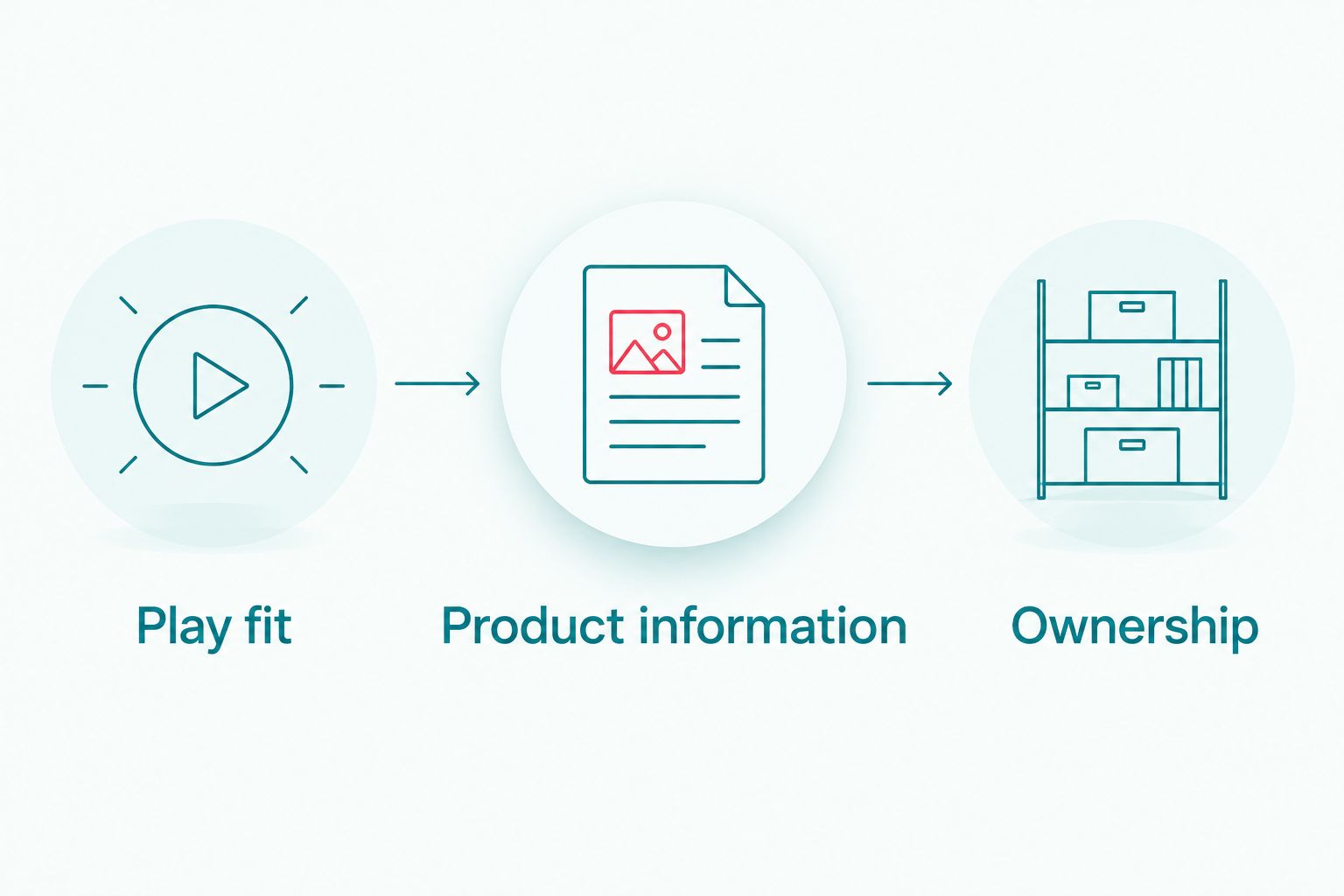
Use 3 checks before choosing a shop or shopping route: play fit, product information and ownership. These are decision prompts, not a sustainability score.
Play fit
Write down 1 play idea you want the toy to support. That might be building together, making up stories or taking turns at a game. A clear purpose helps you compare options without treating every attractive toy as a new need.
Look at what your child already enjoys, too. A toy does not have to introduce a completely new activity to be a thoughtful choice; it can support familiar play in a way your household will actually use.
Product information
Read the recommended age, warnings, materials and care instructions for the exact toy. “Wooden”, “natural” and “eco” do not replace those details. Nor does a retailer’s overall positioning tell you everything about an individual item.
If certification matters to you, look for a named claim tied to the product and check what it covers. Do not infer certified sourcing, plastic-free contents or a particular manufacturing location from appearance alone.
Ownership
Ask 2 questions: “Do we want to keep this?” and “Where will it live?” If the answer to the first is no, investigate borrowing. If the second has no answer, pause before adding another large set to your home.
For a gift, ask the parent or carer about both questions. A thoughtful surprise should not leave another family trying to find space for something that does not fit their routine.
A useful comparison ends with a decision you can explain plainly: this toy fits our child, we understand its care and safety information, and we know whether to keep or return it. That is more useful than choosing on an environmental-sounding description alone.
Why people switch from Babipur
A change in your shopping brief is a reason to consider an alternative; it does not mean Babipur has become a poor choice. The useful distinction is between needing another retailer and needing another way to obtain toys.
These alternatives answer different needs:
- You already want HABA: start with a HABA-focused catalogue rather than a wider brand comparison.
- You do not want permanent ownership: investigate a local toy library.
- You prefer an existing toy: explore second-hand options and inspect the individual item.
- You need a narrower gift search: choose by age, play interest and product information before browsing more widely.
None of these reasons depends on a claim about Babipur changing its policies or product quality. Make your 2026 choice around the need you have now, not an assumption that switching shops automatically improves a purchase.
When staying with Babipur is the right call
Stay with Babipur when its multi-brand ethical-shopping focus is what you want. A specialist shop is not automatically better when your priority is comparing brands or combining toys with wider family shopping.
You also do not need to move every purchase to one place. Choose the route that fits each need: a focused retailer for a particular brand, borrowing for temporary use, or second-hand shopping when you can make the necessary checks.
For eco-conscious parenting in 2026, keeping a suitable toy in use matters more than replacing it simply to change where you shop. Start with what is already on the shelf.
FAQ
What’s the best Babipur alternative for HABA toys?
Habauk is the best fit in this comparison when you specifically want HABA wooden toys and children’s games. Its UK online store organises HABA toys by age and category, rather than offering a multi-brand comparison.
Is Habauk more sustainable than Babipur?
This comparison does not establish that Habauk is more sustainable than Babipur. Compare the materials, sourcing claims and care information for the exact toys, rather than assigning an environmental ranking to either shop.
What’s a good Babipur alternative if I don’t want more toys to keep?
A local toy library is the route to investigate if you want to borrow rather than own. Check the service’s catalogue, borrowing arrangements and care requirements before choosing.
Are second-hand wooden toys always a good choice?
No: a second-hand wooden toy needs checks for condition, completeness and safety information. Do not choose an item solely because it is wooden or previously owned.
Are wooden toys automatically more eco-friendly?
No: wooden construction alone does not establish a toy’s environmental impact. Look for product-specific information about materials and sourcing, and consider whether the toy suits your child’s play.
What should I check before buying a children’s game?
Check the recommended age, warnings, player requirements and contents before buying a children’s game. For a used game, confirm that the pieces and instructions needed to play are included.
Should I stop shopping at Babipur?
No: keep Babipur on your shortlist if its multi-brand ethical-shopping focus meets your needs. Choose an alternative when a specific brand, borrowing or second-hand shopping better answers your current brief.
One last thing
Before opening another shopping tab, ask your child to show you a favourite toy. Watch what they do with it: build, sort, invent a story or invite you to join in.
Use that play as your shopping brief. You might find a clear reason to choose something new, borrow something different or simply bring an existing toy back into the day. The next move does not have to be a purchase.