


Can toddlers share wooden toys without fighting over pieces?
Yes, toddlers can share wooden toys without fighting, but they need help with waiting, asking and keeping their hands gentle. Start with play side by side, protect the piece each child is using, and introduce shared turns without expecting every playtime to be argument-free.
- Can toddlers share wooden toys without fighting? Yes, with adult support; wooden toys alone do not prevent disagreements.
- Start with side-by-side play before asking toddlers to build something together.
- Protect the current turn, stop grabbing gently, and give the waiting child something meaningful to do.
- Habauk suits parents browsing HABA wooden toys by age and category; check each toy’s suitability before shared play.
Can toddlers share wooden toys without fighting over pieces?
Yes. Make sharing something you support, rather than a test your toddler must pass. A child can enjoy another child's company and still find it difficult to hand over a favourite block.
Try this sequence during your next playtime in 2026:
- Check suitability. Read the toy's age guidance and warnings for every child joining in. Do not assume a wooden piece is suitable because it looks simple.
- Make room. Give each child a clear place to build, with loose pieces within reach. Avoid putting everything behind another child's tower.
- Begin separately. Let children explore their own pieces before suggesting a shared project. Playing alongside each other counts as playing together.
- Describe the turn. Name who is using the wanted piece and what happens next. Keep your language short and calm.
- Support the wait. Offer another building idea or join the waiting child. If hands become rough, pause the activity and help everyone settle.
You do not need a new toy to try this. For families choosing something new, Habauk organises HABA toys by age and category; use those details alongside the manufacturer's warnings, not as a promise of peaceful sharing.
Why this matters
A pile of wooden blocks does not come with a ready-made agreement about who owns the bridge, which tower matters most or when a turn ends. You help make those boundaries understandable.
For your family's 2026 playtime routine, aim for safe, supported participation, not constant cooperation. A toddler who plays nearby without taking another child's pieces has something useful to practise, even before a shared castle appears.
Keep the goal small. Help your children return to comfortable play after a disagreement rather than measuring success by whether an argument happened at all.
Side-by-side play: best for starting gently
Put a small selection of suitable pieces near each child and leave space between their projects. Invite them to build whatever interests them, without requiring a shared design.
This approach lets both children join the activity without immediately negotiating every decision. You can sit nearby, notice what they are doing and help when someone reaches into another child's work.
The limitation: separate spaces do not make favourite pieces less desirable. If both children want the same shape, you still need to support a turn or offer an alternative.
Avoid assigning permanent ownership to every shared block. Instead, distinguish between pieces someone is actively using and loose pieces available for everyone.
Shared building: best for children who welcome a joint idea
Suggest a project with separate jobs, such as building neighbouring houses or adding a path between towers. Let each child choose whether to join.
Keep the invitation flexible. If a toddler wants to make something different, allow the buildings to sit beside each other rather than insisting they become a single creation.
The limitation: a shared project brings shared decisions. Knocking down a wall, moving a figure or changing a roof needs adult help when children disagree.
Protect the work already underway. Before adding to another child's building, model asking permission; before clearing it away, check whether the builder has finished.
Turn-taking play: best for practising a clear handover
Choose an action with an obvious ending, such as placing a block on a shared tower. Describe whose turn it is, then help the next child join when that action is complete.
Do not introduce a fixed waiting time as though every toddler should manage it. Watch the children in front of you and simplify the activity when waiting becomes the whole experience.
The limitation: a neat turn-taking rule does not remove disappointment. The waiting child still needs your attention, especially when the wanted piece remains in sight.
| Play approach | Best for | What you support | Main limitation |
|---|---|---|---|
| Side-by-side play | Joining without sharing every decision | Separate building spaces and access to loose pieces | Children can still want the same piece |
| Shared building | Children interested in a joint project | Asking before changing someone else's work | Different plans can cause disagreements |
| Turn-taking play | Practising a clear handover | A visible action and help while waiting | Waiting can overshadow the play |
Choose the simplest approach your children can enjoy today. You can move between these approaches during the same playtime; none needs to become a rule for every activity.
Why sharing wooden toys varies
Look at the play situation before deciding a toddler is unwilling to share. These are useful things to check, not a scoring system for your child:
- Access to pieces: notice whether a child must reach across another child's project to find something useful.
- A favourite component: check whether the disagreement centres on a particular shape or colour rather than the whole toy.
- The task itself: distinguish free building from an activity that requires children to use a shared base or tool.
- The handover: make sure children can understand when a turn ends instead of relying on an unexplained instruction to wait.
- The shared goal: check whether both children actually want to build together or whether an adult has chosen that plan for them.
- The moment: notice hunger, tiredness or a wish to stop before asking for more cooperation.
Change something practical before repeating an instruction. Moving loose pieces into reach is more useful than asking children to share a collection they cannot both access.
How do I stop grabbing without starting another argument?
Stop the grabbing while protecting the current turn. Move close, block hitting or snatching gently, and describe what you can see without calling either child naughty or selfish.
Try a short script such as: That block is being used. You can ask for a turn. I will help you wait. These are suggested words for you to adapt, not a demand for your toddler to repeat them perfectly.
If the piece has already been taken, calmly help restore the interrupted play. Avoid leaving the child who grabbed with the disputed piece simply because returning it brings protests.
Then give the waiting child a real next step. Invite them to choose a different shape, build beside you or leave the activity for now; do not make sitting and watching the only acceptable response.
What if the block has been put down?
A block resting on the floor is not always abandoned. It might be part of a road, waiting to become a roof or sitting beside a child who is still building.
Ask before moving it. Where a child has clearly finished, help return loose pieces to the shared area so the next child can use them.
What if someone hits or throws a piece?
Pause play and keep everyone safe. Move the disputed toy out of immediate reach if necessary, attend to anyone hurt and stay close while the children settle.
Save the explanation for a calmer moment. If you cannot keep the activity safe, put it away and choose something else; finishing the tower is not the priority.
How should I arrange a shared play space?
For a simple 2026 setup, use Personal space, Shared pieces and Adult support as your planning prompts. Each child needs somewhere to work, access to available pieces and an adult close enough to help.
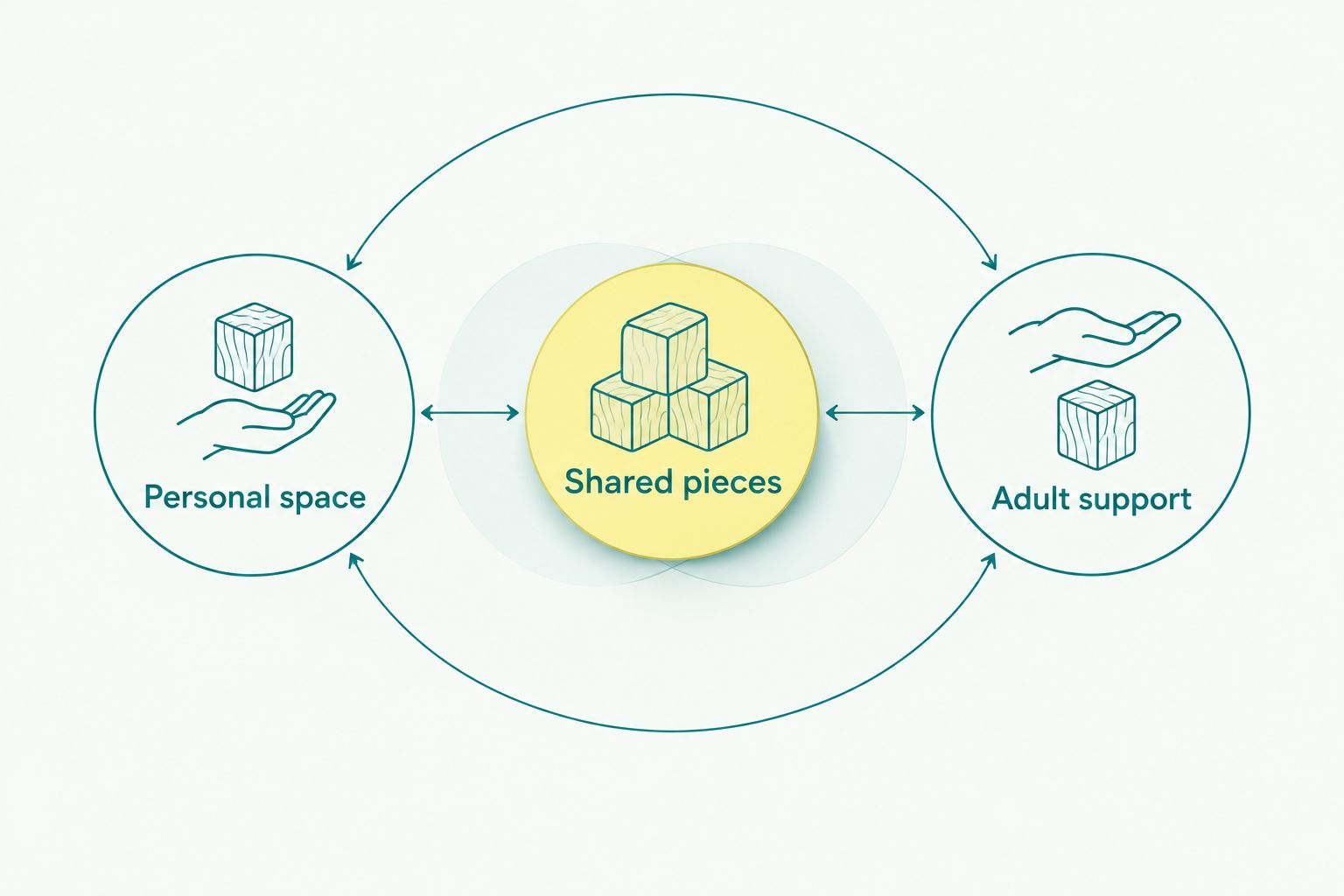
Leave enough clear floor or table space for children to move their arms without disturbing neighbouring work. Keep walkways clear, and do not place building projects where someone must step over them.
Before visitors arrive, let your child put treasured personal toys away. Make the remaining selection clearly available for shared play, while still protecting each child's active turn.
This is not about arranging a perfect playroom. A clear patch of floor and a thoughtful selection of suitable toys are enough to begin.
Which wooden block sets suit shared play?
For a 2026 shortlist, compare what children can do with the pieces rather than treating the biggest total as the answer. Habauk's wooden toy selection includes the building sets below; none guarantees sharing without disagreements.
The supplied product details give piece counts, but not a full breakdown of repeated shapes. Check the current product information before assuming both children can have matching pieces.
| Building set | Supplied size | Best for | Advantage for planning | Limitation |
|---|---|---|---|---|
| Basic Building Blocks 102 Piece Extra Large Wooden Starter Set | 102 pieces | Parents seeking a larger starter collection | More pieces to distribute across separate building spaces | The total does not tell you which shapes repeat |
| Colored Wooden Building Blocks - 85 Piece Set | 85 pieces | Parents seeking a coloured block collection | Offers coloured pieces for building activities | A favourite colour can still become disputed |
| Colored Wooden Building Blocks - 46 Piece Set | 46 pieces | Parents seeking the smaller collection in this comparison | Fewer pieces to lay out and put away than the other listed sets | A smaller total is not evidence of easier sharing |
The Basic Building Blocks 102 Piece Extra Large Wooden Starter Set is described for ages 1 and up. Confirm the age guidance and warnings for every set before choosing it for the children who will share it; do not transfer that age guidance to the other products.


Should I buy duplicates of favourite pieces?
Buy duplicates only when they solve a specific problem you have observed. Matching pieces give children another route into the same activity, but they do not teach a handover or resolve disagreements about someone else's building.
First, try changing access, separating projects or offering a different construction idea. If the same missing component keeps interrupting otherwise comfortable play, check whether an appropriate matching option exists before buying another full set.
Is taking turns the same as giving up a toy immediately?
Taking turns does not require an instant handover whenever another child asks. Help the current player finish a clear action, while supporting the waiting child with another activity or your company.
Avoid making persistent demands the fastest route to a wanted piece. Equally, stay involved if a child collects unused shared pieces simply to stop anyone else joining.
FAQ
Can toddlers share wooden toys without fighting every time?
No toy or routine guarantees an argument-free playtime. Toddlers can share wooden toys with adult support, but disagreements still need calm boundaries and help with waiting.
What's the best way to introduce shared wooden blocks?
Start with side-by-side building and accessible loose pieces. Let children explore separately before inviting them to make a shared construction.
Should I make my toddler hand over a block straight away?
An immediate handover is not necessary simply because another child wants the block. Protect the active turn and help the waiting child find something meaningful to do.
Are wooden toys better than plastic toys for stopping arguments?
Wooden construction does not establish that a toy will prevent arguments. Focus on suitability, access to pieces and how you support the children using it.
Does a bigger block set mean children will share better?
A bigger piece count is not evidence that children will share better. Look at the pieces children actually want, their access to them and whether they can play separately when needed.
What should I do if my toddler throws a wooden piece?
Pause the activity and keep everyone safe. Move pieces out of immediate reach if needed, attend to anyone hurt and resume only when you can support safe play.
Can toddlers of different ages share the same wooden toys?
Use a shared toy only when it is suitable for every child who can reach it. Check age guidance and warnings, and keep unsuitable pieces away from younger children.
One last thing
For your next playdate in 2026, notice the quiet moments as well as the disputes: a child finding another block, building nearby or asking before moving a roof. Describe that action warmly, without turning it into a comparison between children.
Before adding another Habauk wooden toy to your basket, try rearranging the pieces you already have. The next useful change might be a clearer place to play, not a bigger collection.