


Wooden Toys for Babies Learning to Sit Up: 2026 Guide
Wooden toys for babies learning to sit up are toys built for the hands-free window between propped sitting and steady tripod sitting, usually 6 to 8 months, when a baby stops bracing on the floor and starts reaching, grasping and banging with both hands. This stage needs toys that reward two free hands and survive a sideways topple, not toys that need one hand holding a base steady while the other explores.
- Wooden toys for babies learning to sit up should work with two free hands — HABA Color Drops and HABA Magica are grasping toys rated from 6 months.
- Sound and texture beat moving parts at this stage; Fun with Sounds Discovery Blocks and the Fun with Sounds Wooden Eggs give banging feedback without loose small parts.
- Skip any toy that needs a steadying hand — a baby learning to sit still needs both hands free to catch a wobble.
- Rotate toys by what the baby can reach and grip in 2026, not strictly by the age printed on the box.
Why this matters for babies learning to sit up
Most babies sit without support somewhere between 6 and 8 months, and that single shift changes what a toy needs to do. Before this stage, a baby's hands are often busy bracing against the floor, so toys built for wooden teething toys for babies focus on one-handed mouthing because that's mostly what's on offer.
Once sitting is steady enough to free both hands, the same toy category has to do more: invite two-handed banging, reward turning and stacking, and survive getting dropped sideways when balance slips. A baby who topples onto a hard corner learns to avoid that toy rather than keep practicing with it, so shape and weight matter as much as material in a 2026 nursery.
Wooden toys hold up to this stage better than most plastic alternatives because they don't rely on battery covers or small moving joints that loosen with repeated banging. That's the practical case for wooden toys for babies learning to sit up over toys built for older, mobile babies.
How to choose wooden toys for babies learning to sit up
Watch for the sitting-stage signs before you buy
- Baby holds their head steady without bobbing for a minute or more
- Hands leave the floor to reach for an object placed in front
- Baby sits propped against a cushion without sliding sideways within seconds
- Baby brings both hands to the middle to bang two objects together
- Baby recovers from a small wobble instead of toppling straight over
Build a stable base before you add toys
- Use a firm mat or rug rather than a soft mattress that tips the baby
- Sit the baby against a low sofa arm or cushion, not a hard corner
- Clear a knee-high radius of hard furniture edges around the play spot
- Keep the play area on one level — no toy boxes or steps within reach
- Position toys in a loose semicircle so baby doesn't twist too far sideways
Choose grasping toys that work with two free hands
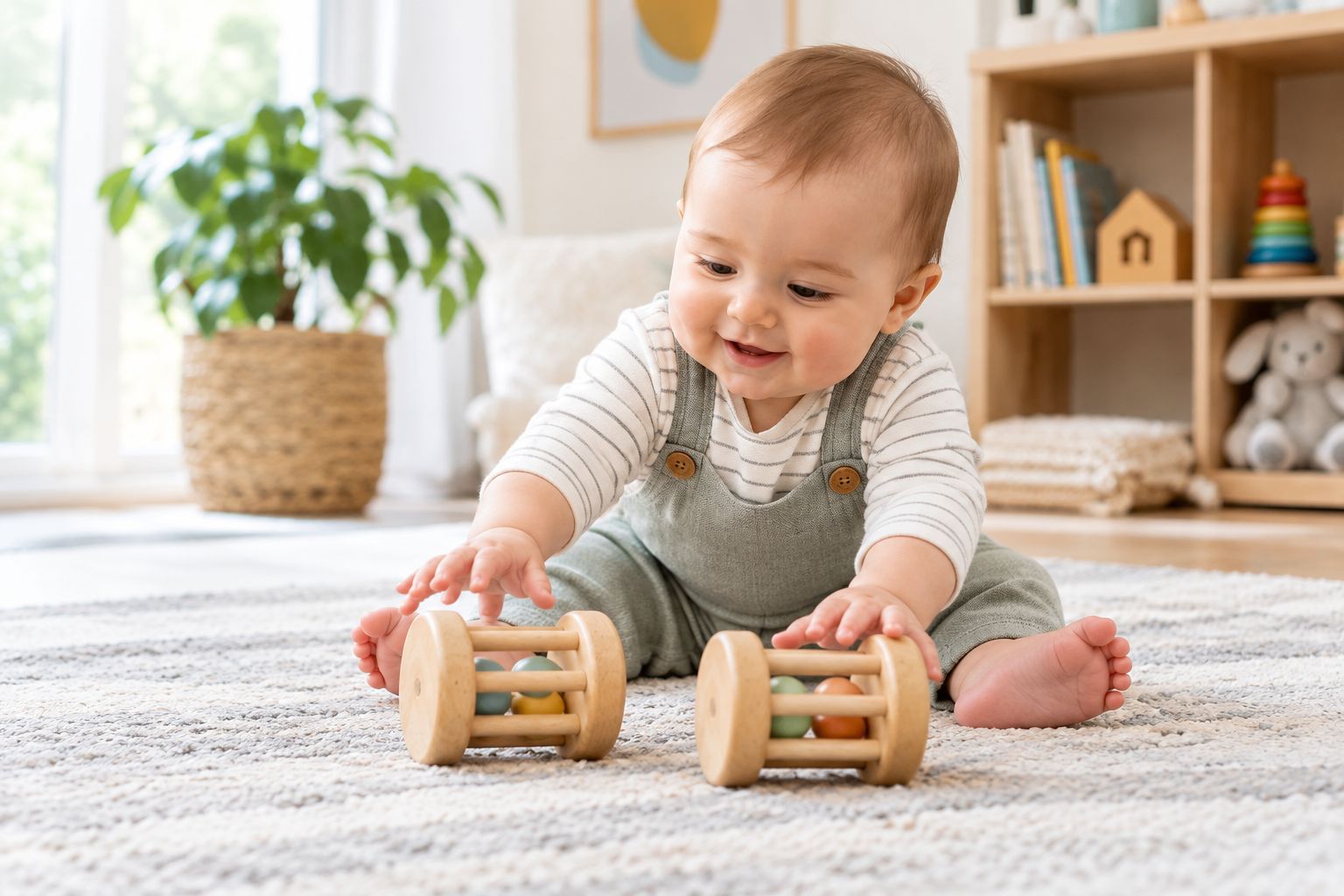
Once a baby can sit without bracing, grasping toys need to work with two hands moving independently, not one hand holding steady while the other explores. HABA's Color Drops Wooden Grasping and Teething Toy is built for exactly this stage: it's rated from 6 months, sized for one hand each, and light enough that a topple doesn't turn it into a hazard.
- Pick toys light enough to lift one-handed at arm's length
- Favor rounded edges over sharp geometric corners for safe mouthing
- Choose two similar-weight pieces so both hands do equal work
- Avoid toys with a fixed base that needs a hand to hold it upright
- Check the minimum age printed on the toy, not just its size
Add sound and texture for two-handed banging
Banging two objects together is one of the clearest signs a baby has hands free for something other than balance. The Fun with Sounds Discovery Blocks give that feedback loop — knock two blocks together and they rattle — without any part small enough to be a choking risk. HABA's Fun with Sounds Wooden Eggs work the same way seated on a mat, shaken rather than banged.
- Look for enclosed rattling parts rather than loose beads or bells
- Pick sets of at least 2-3 pieces so both hands get one each
- Choose pieces sized to stay inside a baby's grip, not roll away instantly
- Test that the sound isn't sharp enough to startle a baby mid-play
- Rotate sound toys in and out weekly so the novelty holds


Rotate toys by reach, not by age label
- Swap in one new texture or sound toy each week rather than all at once
- Watch which toys get dropped after 30 seconds and retire them for a month
- Keep 3-4 toys in the play area at a time, not a full toy box
- Move toys slightly further away once reaching becomes reliable
- Bring back a retired toy once a new skill makes it interesting again
Check safety basics every time
- Confirm no toy has a cord, ribbon or loop longer than a baby's arm
- Check painted or varnished surfaces are labelled safe for mouthing
- Inspect wooden joints and seams for splitting after washing
- Remove any toy with a part smaller than a baby's closed fist
- Recheck safety after every wash — moisture can loosen glued parts
Plan the next stage before this toy box is outgrown
- Look ahead to pulling-to-stand toys once sitting is fully steady
- Keep a shape-sorting or stacking toy in rotation to bridge sitting and crawling
- Consider a wooden activity cube for the weeks before crawling starts
- Hold off on toys with small removable pieces until pincer grip is reliable
- Watch for a baby mouthing toys less often — that's often the crawling-stage signal
Wooden toy options for babies learning to sit up, compared
| Option | Best for | Key limitation |
|---|---|---|
| HABA Color Drops | Two-handed grasping practice while sitting | Doubles as a teether, so it needs regular checks and washing |
| HABA Magica | Early shake-and-explore before sitting is fully steady | Less useful once a baby wants to bang two toys together |
| Fun with Sounds Discovery Blocks | Two-handed banging with sound feedback | Blocks can roll out of reach on hard floors |
| Fun with Sounds Wooden Eggs | Shake-and-listen play seated on a mat | Not a first teether — smoother grasping toys usually come first |
Verdict: HABA Color Drops is the strongest single pick for a baby who has just started sitting unsupported — it's rated from 6 months, works one piece per hand, and doesn't need a base held steady. Buy it as the first grasping toy of this stage; add the Discovery Blocks once banging starts.
Common mistakes parents make at this stage
- Buying toys that need a steadying hand — that defeats the point of two free hands
- Choosing sharp-cornered geometric toys before balance is fully reliable
- Skipping rounded, mouth-safe edges because "it's not a teether anymore"
- Buying ahead for crawling-stage toys before sitting is steady enough to enjoy them
- Playing on a hard floor where banging toys roll away every few minutes
FAQ
What age do babies start learning to sit up?
Most babies sit without support somewhere between 6 and 8 months, though some manage brief unsupported sitting a little earlier. Head control and reaching with both hands usually arrive around the same window.
What's the best wooden toy for a baby learning to sit up?
The HABA Color Drops Wooden Grasping and Teething Toy is the strongest single pick because it's rated from 6 months and works one piece per hand without needing a steadied base. Add a sound toy like Fun with Sounds Discovery Blocks once banging starts.
Are wooden toys safe for babies who are still teething?
Rounded, unvarnished-edge wooden grasping toys sized for one hand are generally safe for mouthing at this stage. Check the toy's own care and safety guidance and inspect joints regularly, since sitting-stage babies still mouth toys often.
How much floor space do sitting babies need for wooden toys?
A knee-high radius clear of hard furniture edges is enough for most sitting-stage play. Toys work best arranged in a loose semicircle so a baby doesn't have to twist far sideways to reach one.
Can babies play with wooden building blocks before they can sit?
Babies who aren't sitting yet can still handle single lightweight blocks lying down or propped, but two-handed stacking and banging really only start once sitting is steady. Wait for reliable sitting before introducing larger block sets.
Is Fun with Sounds Discovery Blocks suitable for a 6 month old?
Fun with Sounds Discovery Blocks are designed for hands-on sound exploration and work well once a baby can sit and bring both hands together to bang objects. Check the product's own age guidance before buying.
What's the difference between a grasping toy and a teething toy?
A grasping toy is shaped and weighted for a baby's hand to hold and manipulate, while a teething toy is chosen mainly for mouth-safe edges and texture. Many wooden toys for this stage, including HABA Color Drops, do both jobs at once.
Do sitting babies need toys with wheels or moving parts?
No — wheeled and mechanical toys usually suit the next stage, once a baby is crawling or pulling up. Sitting-stage babies get more out of grasping, sound and texture toys that don't need one hand to hold a base steady.
One last thing
The toy that stays in rotation longest at this stage usually isn't the flashiest one on the shelf — it's the pair of matching, palm-sized pieces a baby can bang together without a base tipping over. A baby learning to sit is still testing balance every time they reach for something, and an oddly weighted or top-heavy toy makes that test harder instead of more fun. In 2026, that's the single filter worth applying before anything else: pick the toy a baby can use with both hands free, not the one with the most features printed on the box.